[SMM Analysis] Impact of US Tariffs on China on China's ESS Battery Cell Export Methods to the US and Prices - Exploration of Three Methods: "Direct Export from China, Re-export via Malaysia, and US Domestic Production" (Part I)

Published: May 30, 2025 19:20
[SMM Analysis] This article is the first in the series, aiming to analyze the impact of price changes on energy storage battery cells produced in China through direct export, re-export via Malaysia, and the potential impact if the US were to produce LFP (for ESS) battery cells locally during the period from May 14 to August 13. Some of the data values are relatively theoretical, which may result in seemingly high outcomes. The author will endeavor to explain in detail the reasons for each data value, enabling readers to subsequently replace the relevant data themselves to obtain more targeted conclusions. There will be follow-up articles (Part II and Part III) aimed at analyzing the price impacts caused by different tariffs at subsequent time periods.

On May 28, 2025, the US Court of International Trade in New York ruled that the executive order issued by the US government to impose tariff hikes on multiple countries under the International Emergency Economic Powers Act was an ultra vires act and illegal, prohibiting the implementation of the relevant executive order. The reason was that the President did not have the authority to impose comprehensive tariffs on nearly all trading partners, and that Congress's delegation of "unrestricted tariff authority" to the President violated the Constitution. Additionally, Congress had set limits in the International Emergency Economic Powers Act to restrict the President's power to impose tariffs. However, Trump indicated that he would still appeal the ruling, so there remains significant uncertainty regarding changes to US tariffs on China.

Nevertheless, according to the ESS tariff measures currently being implemented, there are three periods: May 14, 2025, August 13, 2025, and January 1, 2026, with tariffs of 40.9%, 64.9%, and 82.4%, respectively.

This article is the first in the series, aiming to analyze the impact of price changes on ESS battery cells produced in China through direct exports, re-exports via Malaysia, and the potential local production of LFP ESS battery cells in the US between May 14 and August 13. Some data values are more theoretical, so the results may appear high. The author will explain in detail the reasons for each data value to enable readers to replace the relevant data themselves and obtain more targeted conclusions. Subsequent articles (II) and (III) will analyze the price impacts caused by different tariffs in the subsequent two periods.

Taking domestically produced 280Ah LFP ESS battery cells as an example:

(1) Direct exports from China to the US: The data sources and changes for each link are shown in the table below.

(2) Re-exports from China to the US via Malaysia: The data sources and changes for each link are shown in the table below.
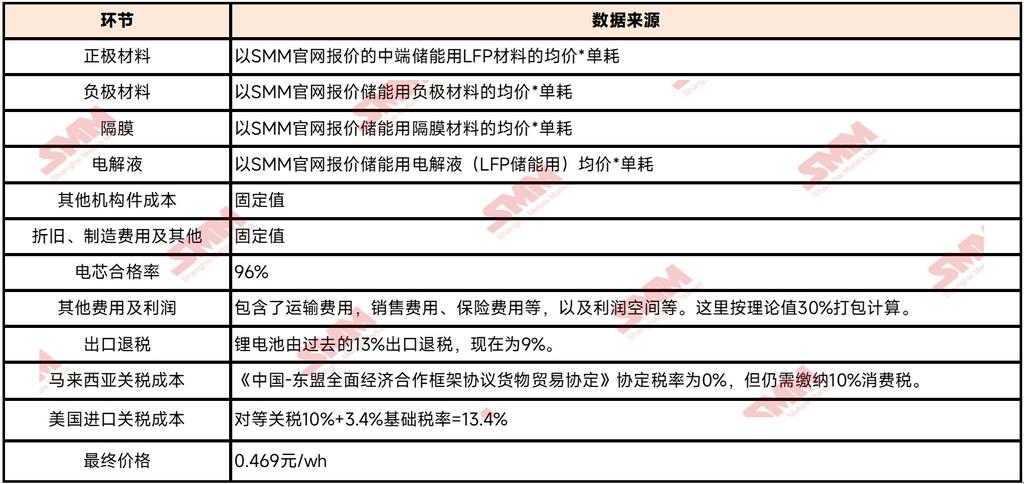
(3) US imports of raw materials for local production of battery cells: The data sources and changes for each link are shown in the table below.

Note: Given China's extremely high global market share in the LFP and artificial graphite anode sectors, it is considered unlikely that the US could bypass China to directly import relevant raw materials. Therefore, corresponding tariff changes will also apply to the materials mentioned below.

Based on the above calculations, at the current stage, with the price of battery cells directly exported from China at 0.52 yuan/Wh, re-exporting via Malaysia offers a 9.8% price advantage, while the cost of directly producing ESS battery cells in the US remains 8.6% higher than in China.

The above content is summarized as follows:

Note: Some of the calculated data were obtained by the author through discussions and processing in the market, while more data were sourced from the average prices at various price points on the SMM official website. In addition, in the current actual operation, the increased costs resulting from the US tariffs on China are mainly borne by overseas customers. Therefore, the calculation results in this article may be higher than the actual transaction prices. Any inappropriate content is open to criticism and correction.


SMM New Energy Industry Research Department

Wang Cong 021-51666838

Ma Rui 021-51595780

Feng Disheng 021-51666714

Lv Yanlin 021-20707875

Zhou Zhicheng 021-51666711

Zhang Haohan 021-51666752

Wang Zihan 021-51666914

Wang Jie 021-51595902

Xu Yang 021-51666760

Chen Bolin 021-51666836
Data Source Statement: Except for publicly available information, all other data are processed by SMM based on publicly available information, market communication, and relying on SMM‘s internal database model. They are for reference only and do not constitute decision-making recommendations.

For any inquiries or to learn more information, please contact: lemonzhao@smm.cn
For more information on how to access our research reports, please contact:service.en@smm.cn
Related News
Beijing Launches 500-kV Power Project in Fengtai, Boosting Grid Resilience and Industrial Growth
17 hours ago
Beijing Launches 500-kV Power Project in Fengtai, Boosting Grid Resilience and Industrial Growth
Read More
Beijing Launches 500-kV Power Project in Fengtai, Boosting Grid Resilience and Industrial Growth
On January 28th, the construction of the 500-kilovolt power transmission and transformation project in Fengtai, Beijing officially started. This project is the first newly-built 500-kilovolt power grid project in Beijing during the 15th Five-Year Plan period. It will significantly enhance the resilience and power receiving capacity of the southern Beijing power grid and provide reliable power support for Beijing to continuously optimize the investment structure and vigorously develop high-end, precise, and cutting-edge industries. The 500-kilovolt power transmission and transformation project in Fengtai, Beijing is a key project of Beijing's power grid during the 15th Five-Year Plan period and one of the "3 100" key projects in Beijing this year. It is constructed and managed by the State
17 hours ago
Shaanxi-Anhui UHV DC Project's 500-kV AC System at Hezhou Station Begins Operation After Trial Run
17 hours ago
Shaanxi-Anhui UHV DC Project's 500-kV AC System at Hezhou Station Begins Operation After Trial Run
Read More
Shaanxi-Anhui UHV DC Project's 500-kV AC System at Hezhou Station Begins Operation After Trial Run
On February 1st, the 500-kilovolt AC system of the Hezhou Converter Station, the receiving-end station of the ±800-kilovolt UHV DC power transmission project from northern Shaanxi to Anhui, was officially put into operation after a 24-hour trial run.
17 hours ago
750-kV Power Line Connecting Northern to Central Shaanxi Fully Operational
17 hours ago
750-kV Power Line Connecting Northern to Central Shaanxi Fully Operational
Read More
750-kV Power Line Connecting Northern to Central Shaanxi Fully Operational
On February 2nd, the 750-kilovolt power transmission and transformation project of the third passageway from northern Shaanxi to central Shaanxi was fully connected. The project starts from the 750-kilovolt Shuofang Substation in Shenmu City in the north and ends at the 750-kilovolt Bailuyuan Substation in Lantian County in the south. It has newly built a 1,271-kilometer line, passing through 18 counties (districts) in 4 cities including Yulin, Yan'an, Weinan and Xi'an.
17 hours ago